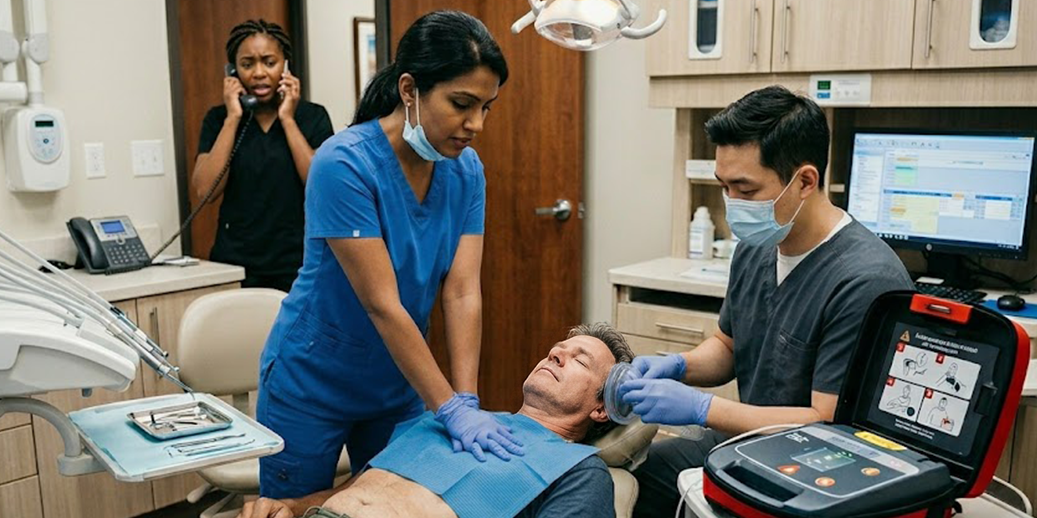
Emergencies Don’t Schedule Appointments. Is Your Dental Office Ready?
They are unpredictable, high-stakes, and often unforgiving. While they may be rare, their impact—on patients, teams, and practices—can be profound. The real question isn’t if an emergency will happen in your office; it’s will your team be prepared when it does?
Most medical emergencies do not begin as dramatic, obvious events. They start quietly. A patient becomes slightly pale. A shift in breathing pattern. A subtle change in responsiveness. These early indicators are easy to overlook in a busy clinical environment, but they are often the first and best opportunity to intervene. In many cases, the difference between a controlled situation and a true crisis is measured in minutes.
Every dental office has protocols. Fewer have protocols that are truly operationalized. In an emergency, there is no time to pause and figure things out. Roles must be clear, actions must be immediate, and communication must be seamless.
High-performing teams don’t just know what to do—they’ve practiced it. They have walked through scenarios, clarified responsibilities, and built the kind of muscle memory that only comes from repetition. Without that preparation, even the best-written protocol can fall apart under pressure.
Emergency preparedness is not just about knowledge—it’s about readiness. Having the right drugs and equipment on hand is essential, but that is only part of the equation. Teams must also know where everything is located, when it should be used, how to use it confidently and correctly—because in an emergency, hesitation is the enemy.
No single provider can manage a medical emergency alone. Effective response requires coordination, communication, and trust across the entire team.
Who calls emergency services? Who retrieves the emergency kit? Who monitors the patient? Who documents the event? When these roles are predefined and practiced, the team moves as one. When they are not, confusion takes over.
For many practices, emergency preparedness is treated as a checkbox—something done to meet requirements. But true readiness goes beyond compliance. It’s about creating a culture of safety, where preparation is continuous and confidence is earned.
Emergencies may be unpredictable. Your response doesn’t have to be.
************************
For dental professionals looking to strengthen their skills in this area, the Southwest Dental Conference provides this course on early recognition, practical protocols, essential equipment, and team-based response to transform preparedness from a concept into a capability:
Avoiding Disasters: Emergency Management in the Dental Office
Instructor: Andrew Read-Fuller, DDS, MD
Audience: All
Time: 1:00-4:00 p.m.
Fee: $55
Course #F30
CE Hours: 3 technical and/or scientific
AGD Subject Code: 142
Register for this course and more at swdentalconf.org.
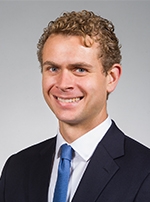
Andrew Read-Fuller, DDS, MD, FACS, FACD is Clinical Associate Professor and Residency Program Director of Oral and Maxillofacial Surgery at Texas A&M College of Dentistry. He received his certificate in oral and maxillofacial surgery from UT Southwestern Medical Center in 2017, after receiving his MD degree in 2014 from the UT Southwestern Medical School and graduating Magna Cum Laude from the UCLA School of Dentistry in the concurrent DDS/MS program. Dr. Read-Fuller is certified by the American Board of Oral and Maxillofacial Surgery and was awarded the Faculty Educator Development Award by AAOMS in 2018 for his dedication to postdoctoral education in OMS as well as the Dallas County Dental Society New Dentist of the Year Award in 2023. He has held numerous national and international leadership positions in oral and maxillofacial surgery including serving as President of Dallas County Dental Society, board member for the Texas Society of OMS and OMS Foundation, chair of the AAOMS Committee on Continuing Education and Professional Development, and the North American Representative to the NexGen Committee of the International Association of OMS. Dr. Read-Fuller is interested in the broad scope of oral and maxillofacial surgery, with particular interest in the treatment of facial trauma, temporomandibular joint disease, dental implantology, orthognathic surgery, pathological lesions of the face and jaws, and peripheral nerve repair.